Showing posts with label lavoro. Show all posts

Monday, November 30, 2020

The grey month

November has always been associated with depression, but this year, we all have a bunch of reasons to be sad. 
  • 2/11 terroristic attack in the heart of Vienna
  • 4/11 and 11/11 Remembrance Day for the end of WWI
  • 12/11 one-year anniversary after the "flood" in Venice and 17 years after the terroristic attack against the Italian army in Nasiriyah 
  • 13/11 5 years after the terroristic attack in Paris, which changed Europe
Not to mention the Christian celebrations in November, from All Souls' Day (2/11) to the Buß- und Bettag (18/11). In addition, we are in the middle of a pandemic, which is not getting any better, it led to a second lockdown in Austria and will hamper the possibility to celebrate Christmas with the family in Italy. This year has been bad enough, but I'm afraid that it will be even worse. We hope in 2021, but we don't know whether it will actually be better or not.
 
Prato della Valle (Padova) in the fog.
Apart from those anniversaries and events, the sky is often grey, the temperature is already quite low and the daylight every day shorter. If we add the social distancing recommended in the fight against the pandemic, we have the perfect recipe for depression

Well, except for the pandemic, the other sadness factors are the same every year. How did I survive this grey period in the past? As Facebook constantly remember, I was travelling, meeting friends and family, going to concerts and operas, and splitting my time between intense work and music practising. This year, I cannot travel, thus I cannot visit my parents. It is allowed to meet just one friend at the time and possibly always the same person, but I'm not meeting anyone except virtually. Concerts, operas, and even religious services are cancelled. Some of these activities take place on the web now. I meet colleagues and friends, I have lunch or dinner with my parents, I watch concerts and operas live, I attend scientific conferences in the USA and Japan, everything in front of a screen. Music practising is still allowed, especially since I bought a digital organ, which even enables virtual lessons. Fur sure, not the same as meeting my teacher or my pupils in person, playing a real instrument in a cold church, but better than nothing. In addition, I'm not regularly going to the office. Many of us are working again from home. The daily discussions (sometimes even arguments) moved onto WhatsApp, Zoom, Skype or via e-mail. I have to drink my coffee and cook my lunch, but I can use my personal toilet and I can work in slippers and pyjama. Nevertheless, I miss the interaction with colleagues. 
 
However, what kills the most in this period is the uncertainty. The hesitation of politicians in defining a line of conduct. The question marks on the re-opening of the normal activities and on Christmas celebrations. Everyone can survive a period of loneliness and isolation, but not knowing when (or if) this will end is terrible and makes this month one of the saddest of the year.


Saturday, June 6, 2020

Quarantine: What I liked and what I didn't.

The pandemic is not over, yet. However, Austria is back to work, slowly, between resilience, anger, and worry. Three months ago, we were recommended to stay home, going out only for essential needs, whereas most of the commercial and cultural activities were closed. My employer was kind enough to allow working from home. For 7 weeks, I watched the world from either my windows or the screen of my laptop. Was it a completely negative experience? Did I learn something? Here it is, the list of the 5 things I liked of this time and the 5 I hated. As reminder, in case we have to experience another lockdown, soon or later.

"Staying home", when you can take the house with you.
The top 5 things I liked:
1. Working from home. It is called "home office" in Austria, "teletravail" in the French-speaking part of Belgium. I wouldn't do it every day, but I'd like the opportunity to work from home some days of the month, when I have to write a proposal or a paper and I really need a quiet environment. I missed my colleagues, the lab tools, and the creative interaction of the office, but sometimes, I need to work in a "monastery".
2. Dress code. I'm Italian, I cannot dress bad. This causes me a lot of stress. Every morning, I have to decide what to wear. I dream of uniforms, because I'd have no choice. Staying home, I didn't have to change outfit every day. I was dressing like I was going out (i.e., not wearing the pajama during the day), but without paying too much attention to colors, fabric, etc.
3. Cooking. Time for experimenting, eating healthy, without having to improvise at the last minute. I didn't bake bread or cookies, like many others, but I dedicated more time to prepare healthy and tasty recipes, although with a few ingredients.
4. Regularly playing music. Generally, I am too tired, when I come home, or it is too late to play organ, mandolin, recorder, or singing. In this time at home, I spared the commuting time, using it to practice.
5. Virtual conferences. All the international conferences in cool places I planned to attend were postponed or transformed into virtual events. Even though a virtual conference is not s effective and enjoyable as a real one, I liked the opportunity to attend for affordable prices high-quality international meeting, without having to stay in a hotel or flying 12 hours (although I miss travelling a lot, mostly by train). In this category, I'd include the virtual masses, too. I still prefer going to the church, but in this period, I could attend masses celebrated by good priests that I could have not heard otherwise.

He hates staying home, but luckily, my parents have a garden.
The top 5 things I hated.
1. Making the dishes. This is something I hate in normal time. Eating at home and cooking elaborate recipes imply getting so many plates and tools dirty. I have a dishwasher, but I use it twice a year. It takes too long and is not worth for a person alone.
2. The dust. Vacuum cleaning is OK, but how is it possible that every day so much dust piles up in my flat? When I go to work, I do the cleaning on the weekend. During the week, I've never noticed dust so much as staying at home. I was cleaning every day.
3. Neighbors. Especially those with kids. When I tried to focus on something or when I wanted to enjoy the sun from the window, they were loudly playing. When I wanted to play music or talking with friends by phone, they started knocking on the wall or on the door, probably because the child just fell asleep. Not mentioning those neighbors watering their plants on the roof terrace at 5:30 am, causing a waterfall on my window.
4. Eating alone. Even though I like the monastery life, I like to share the time at the table. A temporary solution was introducing the virtual lunch with my parents, also to overcome the impossibility to travel to Italy.
5. Friends moaning about everything. It was difficult for everybody, I understand that having also the kids at home makes life much more difficult, but you wanted to have children, you always complain that you haven't enough time to spend with them, why are you complaining also now? Not mentioning the friends moaning for having to stay home and verbally attacking those, who went out (even where it was permitted, like in Vienna). Then those complaining about the weather ("it rains and I cannot go out", "it is sunny and I cannot go out"). I mean, we were all in the same situation, let's share feelings rather than complaints.

What did I learn? The next time, is it ever happens again, I will start earlier with the virtual social events. I realized that I became somehow misanthropic, but I always disliked hugging people. However, I might try to communicate with my neighbors, trying to find an agreement rather than hating each other. Finally, I should seriously consider the idea of adopting two cats.

Monday, April 13, 2020

Why did I take a vacation before Easter?

I decided to take a few days vacation during the Holy Week. All my friends and colleagues asked me why. I am allowed to work from home, I was not forced to use vacation days by my employer, as unfortunately happened to some friends and colleagues. Of course, I didn't go anywhere, traveling is not even permitted. Why did I take a vacation, then?
 
Reason 1. I’ve been keeping my daily routine: waking up early, breakfast, shower, dressing, then sitting at my desk (table in the living room) until late afternoon, with a short lunch break. I am saving the time to go back and forth from the office, but I feel the pressure that I have to work. My creativity was low as well as my productivity. I realized that I needed a break. Until now, it was provided by a trip with friends, an evening at the restaurant or at the theater, or even the coffee break with my colleagues.

Reason 2. I wanted to celebrate properly not only Easter (including the Triduum), but also my 40th birthday. In other times, I would have travelled to Italy or my parents would have visited me. In any case, I would have taken some days off. Even though I stayed home, I wanted baking cakes and cooking family recipes, calling (or being called by) family and friends, virtually attending religious services, etc. During this isolation time, every day is the same as the other, but these dates require to be different. By the way, some friends found the way to surprise me despite the seclusion, making these days unforgettable.

Reason 3. I know that it doesn't bring anything to the colleagues that were asked to use their vacation days, but I wanted to show a sign of solidarity. I see the point of our employers. We scientists can still deliver our products (papers, proposals, etc.) from home, even though soon or later, we will run out of data and ideas without accessing samples and labs, but for now, we just need a laptop and a reliable internet connection. Even as guest lecturer at the university, I can continue to provide my classes. Technicians cannot work from home. The instruments they need are not available in any shop and cannot be transported also for safety reason (size, weight, high voltage, etc.). It is even worse for other categories, like people working on short term contracts in theaters or opera houses, people working in museums as watcher in the exhibition or in the ticket shop, hair dressers, cleaning companies, etc.
 
I must admit that, despite the situation, I enjoyed these days off and I got back my creativity and enthusiasm for working in science. I hope that the next time I'll take vacation will be for travelling abroad (by train, as usual), for meeting again my parents, and for celebrating with friends the end of this difficult period.

Saturday, August 31, 2019

News! News! News! I stay in Vienna!

Recap of my "career" abroad, for whose of you, who missed the regular updates. In 2010, I left Italy for the first Viennese experience (here it is when I arrived and when I left). In 2013, I moved to Brussels (impressions upon arrival and departure). Finally, the joy to come back to Vienna. And now? The research project that has brought me back and has funded me for the past three years is over, but I understood that I don't want to leave this city.

The dome of the NHM
I didn't have time to think much about "what to do next", because in between I was invited for a job interview (in German) and... I got the position, starting now! A job as scientist and curator at the Natural History Museum of Vienna! There is still  a probation time, but I hope I'll be confirmed. You cannot imagine how excited I am. It is a bit like being in a pastry shop for a greedy kid. Heaven. I'll work in a building that is more than a century old, with a collection that is much older. I believe, I'm the only Italian working in the museum, I don't know if I'm also the first, although there are other "foreigners" among the employees, mostly from Germany. Well, I still come from an ex-colony of the empire... I must admit that the experience in Brussels has contributed to obtain this position.A bit longer than 10 yrs after my PhD, 9 1/2 years after moving abroad, I got a permanent position, which means that I don't have to restart my life somewhere else every 2-3 yrs, unless I want it. This time, I don't need to organize a farewell party and saying goodbye to my friends and former colleagues. I have the opportunity to stay in Vienna, my new home. This doesn't mean that I'll sit tight, not advancing anymore. I have plans, also in academia, on parallel, but with the security of a permanent position. And I'll continue playing music. It is a part of me that here is accepted and even appreciated.

Now, it's time to update the list of the good and bad characteristics of the city. There are still musical trains, perhaps less telephone booths, the selection of cakes is always impressive, and my weekends are very often booked. In the meantime, they learned to fill sandwiches, but not to distribute along an half-full train, church- and TV-taxes are present, perhaps smoking will be forbidden at last, but you can still be killed by a "Dachlawine" and left speechless by dialect terms. The number of mad people seem to have increased in the last years, but those dangerous are limited. The climate is changing, hotter in summer and less snow in winter, but the city administration is taking action to mild the effects on the population. In conclusion, I can definitely live with the few things I don't like in Vienna. Nobody is perfect! (cit.)


Saturday, March 16, 2019

L'Italia degli Azzeccagarbugli

Tempo fa, all'inizio della mia esperienza all'estero, scrissi dei problemi incontrati cercando di aggiornare il mio profilo nel sito del MIUR per poter continuare ad essere contattata per supplenze nelle scuole superiori della mia regione. Dopo oltre nove anni dalla mia partenza mi sono ritrovata a litigare nuovamente con quel sito per poter partecipare alla selezione per ottenere l'ASN (abilitazione scientifica nazionale). Recuperare le credenziali per accedere al sito e' stato relativamente facile, nonostante il sistema ricordasse ancora il mio indirizzo mail dell'università di Padova. Ho ricevuto risposta nel giro di qualche ora ed il disguido è stato presto sistemando. Presentare domanda ha richiesto parecchia pazienza, anche per "tradurre" in modo comprensibile sia il linguaggio burocratico dei parametri richiesti, sia le mie esperienze lavorative estere, classificate in inglese quando non in altre lingue (tedesco e fiammingo). Poi c'è stata l'attesa, mesi, esattamente  sei. Non contavo di ottenere l'ASN perché dopo il dottorato ho abbandonato il tema di cui mi occupavo per dedicarmi ad un campo difficilmente inquadrabile nei rigidi settori disciplinari descritti dal ministero. Valeva comunque  la pena tentare, avendo i titoli per farlo. A sorpresa sono stata abilitata e con giudizi positivi. E' stato un onore.

Ed ora? In teoria, posso concorrere per un posto da prof. associato in tutta Italia, ovviamente nelle discipline in cui sono stata abilitata. Ho trovato un sito ufficiale ove vengono pubblicati i bandi, senza dover scorrere ogni settimana la Gazzetta Ufficiale. Peccato che sembra che il nuovo governo abbia deciso di bloccare le assunzione per tutto il 2019. Se accadesse, non solo non uscirebbero nuovi bandi ma anche perderei un anno di validità dell'abilitazione, che dura sei anni, ossia... se non si viene assunti entro questo termine bisogna ripetere la procedura. Un po' diverso dal sistema austriaco, in cui l'abilitazione è sì un titolo a scadenza, ma che viene automaticamente rinnovato insegnando, almeno all'Università di Vienna. Quindi l'Italia non e' più il paese degli Azzeccagarbugli come l'avevo definito anni fa? Magari! E' uscito un bando per un istituto di ricerca che non e' università. Consta di 45 pagine, di cui le prime 30 almeno sono solo di leggi e commi incomprensibili. Tra le richieste manca il certificato di esistenza in vita che invece trovai in un bando per il CNR e che tanto fece ridere i colleghi di qui. Chi volesse partecipare, leggendo fino in fondo le famigerate 45 pagine, troverebbe tra i possibili mezzi di comunicazione la PEC (e-mail certificata, a pagamento, possibile solo facendola fisicamente in Italia la prima volta e non credo di poterla avere come residente all'estero) o la classica raccomandata con ricevuta di ritorno, in cui fa fede il timbro postale. A metà dicembre ho inviato delle cartoline dal Giappone all'Europa, le colleghe in Austria ed in UK hanno ricevuto le loro già al 2 gennaio, al rientro dopo le feste, mentre in Italia sono arrivate quasi a fine mese. Figurarsi se mi fido di una raccomandata, con tutto quel che costa inviare un plico cartaceo in tale forma, perché vogliono pure il CV in formato europeo (unici in Europa a richiederlo ed a conoscerlo), il quale essendo scritto solo su metà foglio diventerebbe di 50 pagine almeno nel mio caso, anche per la modalità d'inserimento delle esperienze e per gli spazi vuoti previsti.

Bandi a parte, visto che non ho intenzione di tornare in Italia per il momento e che l'abilitazione italiana mi serve principalmente da sprone e da titolo per tentare quella austriaca, non dovrei avvelenarmi il sangue con i normali inghippi italici. Invece ho avuto la bella idea di partecipare ad un convegno nazionale di scienze planetarie, come ho di recente raccontato. Il convegno era a Firenze ma in un campus universitario un po' decentrato. Quando me ne sono resa conto ho dovuto cambiare prenotazione dell'albergo perché altrimenti ogni giorno mi sarei dovuta sorbire almeno 40 minuti di bus. L'organizzazione del convegno, nonostante le migliori intenzioni, è risultata "italiana", dando all'aggettivo il significato di improvvisato e pieno di imprevisti. Da "crucchizzata" ho inviato il mio contributo con largo anticipo sulla scadenza prevista. Il termine e' stato prorogato. Dopo la scadenza della proroga mi contatta l'organizzatore per dirmi che hanno avuto un falso positivo e si sono persi il mio contributo. Peccato fossi già in Italia dai miei ed avessi lasciato il file incriminato nel pc dell'ufficio. Per fortuna ne avevo salvata una copia. Questo scambio di e-mail e' avvenuto la sera dopo le 21 di sabato 22 dicembre. Un tedesco non avrebbe lavorato in tali condizioni, quindi lode all'organizzatore che ha cercato di rimediare ad un problema tecnico dedicando del tempo privato. Il programma e' uscito il 15 gennaio, il convegno è iniziato il 4 febbraio. Se avessi dovuto prenotare un aereo... tanto c'è sempre l'immancabile imprevisto degli scioperi. Il programma era in italiano, con i titoli dei contributi in inglese. Le presentazioni erano in italiano e questo mi ha gettato nel panico, perché sono diventata lenta a parlare la mia lingua in ambito scientifico, non mi vengono più i termini corretti, ammesso di averli mai imparati, avendo cambiato campo di studi. Come mi ha fatto notare una collega tedesca, l'equivalente convegno nazionale in Germania aveva tutti i contributi (almeno il 95%) in inglese, sia perché in Germania ci sono parecchi studenti, dottorandi, ricercatori e persino professori di origine straniera e che non sono fluenti in tedesco e sia perché lo scopo del congresso è anche di attirare ancora di più ricercatori dall'estero. In Italia il provincialismo domina. Insomma, l'internazionalizzazione tanto auspicata resta un'utopia, ma anche semplicemente il funzionamento di un sito o l'incontro tra scienziati, cercando di mettere d'accordo (missione impossibile) un gruppo eterogeneo e polemico.

Venendo dall'estero vivo simili esperienze con sentimenti misti, tra rabbia ed amarezza, rabbia perché persino le cose più semplici diventano complicate ed amarezza perché il potenziale umano è buono ed è un peccato sprecarlo per la burocrazia. In vista del prossimo EGU, convegno che riunisce a Vienna ca. 13000 geologi da tutto il mondo, uno dei miei supervisori di dottorato ha invitato un contributo piuttosto provocatorio, domandandosi come mai l'Italia sia indietro nella ricerca in campo geologico rispetto al resto del mondo. Lui è rientrato da poco dopo un periodo all'estero. L'impatto con la burocrazia che ostacola ogni passo è traumatico. Gli auguro di riuscire a smuovere il sistema, ha tutto il mio appoggio.

Thursday, January 31, 2019

Razza bianca europea

Non è la prima volta che mi candido per un posto in ambito accademico nel Regno Unito, ogni volta sono obbligata a rispondere a domande sull'etnia di appartenenza, la religione e l'orientamento sessuale per la sezione pari opportunità. Da qualche tempo, alla domanda sulla razza, nel menu a tendina compaiono "British white", "Irish white" e "Other white background". In precedenza c'era l'opzione "Caucasian", ora scomparsa. Se uno indica "other", non essendo io né color neve né con i capelli rossi, si viene pregati di specificare. Nello screenshot qui sotto potete vedere la mia provocatoria risposta in tema Brexit: "European".
 

Onestamente, trovo la domanda offensiva. Non è il colore della pelle che fa una persona, ma dove e come è cresciuta ed è stata educata. Il fatto che sia nata in Italia e che l'italiano sia la mia lingua madre ha forgiato il mio modo di pensare, più che essere rosa ambrato ed anemica, con i capelli castani e lisci. Il cittadino italiano è per definizione un misto, nei secoli le nostre coste sono state aperte e sono sicura che in ognuno di noi scorre un po' di sangue spagnolo, arabo, francese, anglosassone ed asiatico. In Giappone e negli USA mi sono sentita chiamare "europea" per la mia cultura ed è quel che mi sento. L'Europa è quella parte di mondo dove ci si fa la guerra tra villaggi, si parlano milioni di variazioni delle già molteplici lingue nazionali ed in cui tutti hanno una memoria storica comune, dominata per lungo tempo dalla presenza della Chiesa e da sanguinosi conflitti. Che lo si voglia ammettere o meno. Agli occhi di un americano, un abbronzato cattolico spagnolo non è diverso da un pallido ateo norvegese.

Il ridicolo delle domande continua con la nazionalità, quando sotto "Italy" non compare "includes San Marino", come avrei potuto comprendere per ridurre il numero di stati elencati, ma "includes Sardinia, Sicily". È vero, gli isolani tendono a chiamare "Italia" o "continente" la penisola, ma si sentono sicuramente più Italiani di una buona percentuale di altoatesini. L'aggiunta non era assolutamente necessaria.

Alcuni conoscenti hanno recentemente lasciato il Regno Unito per tornare in Italia, in parte per lo spauracchio della Brexit (i ricercatori inglesi sono egualmente terrorizzata dall'eventualità che i fondi europei non siano più accessibili) ed in parte perché nelle università italiane si stanno creando le opportunità per un rientro. Magari, come "minoranza" europea che invece anche in questo momento accetterebbe di andare in Regno Unito, ho qualche possibilità in più per il bando di cui sopra.

un'italiana in Europa

Thursday, February 22, 2018

Berlinare

A volte ritornano. Anzi così spesso da coniare un termine apposito. Mi riferisco ai miei viaggi di lavoro a Berlino. Da quando sono espatriata, grazie ad una fruttuosa collaborazione, almeno una volta all'anno mi trovo a trascorrere qualche giorno nella capitale tedesca. La permanenza più breve è stata di un giorno, prendendo il primo volo al mattino da Vienna e ritornando la sera, quella più lunga due settimane. Senza contare le numerose volte in cui sono passata dalla città, pur avendo altra destinazione, tipo Potsdam o Dresda. Lo scorso weekend ci sono tornata per partecipare al simposio in onore del professore con cui ho lavorato che va in pensione. Eccezionalmente non viaggiando da sola come mia consuetudine, bensì con due colleghe: la mia compagna d'ufficio tedesca ed una nostra ex-dottoranda turca.

A dire il vero, non abbiamo propriamente viaggiato assieme. Potendo rimborsarmi il viaggio di lavoro, ho preferito volare con la compagnia di bandiera, mentre loro hanno preso un volo low-cost. All'andata sullo stesso velivolo c'era il nostro capo con la moglie. Al ritorno un attore italo-austriaco che aveva visitato la Berlinale. Il nostro capo è più spesso in tv di tale attore e quindi in teoria più famoso, ma solo la sottoscritta e l'ex direttore del Film Museum di Vienna gli hanno rivolto la parola. Veramente tutti hanno rispettato la privacy dell'attore, nessuno l'ha tormentato per autografi e selfie... come probabilmente sarebbe accaduto nel nostro paese. Divagazione a parte, pur se non per il volo, per il resto del tempo sono sempre stata con le colleghe, dalla stanza d'hotel allo shopping. L'hotel, in cui ero già stata, è a Wedding. Nonostante Wedding non sia affatto il quartiere migliore di Berlino, non mi ci trovo male perché multiculturale, animato e fornito di ogni comodità. Come nelle barzellette, ci siamo ritrovate una turca musulmana, una tedesca luterana ed un'italiana cattolica a Berlino. La convivenza è stata senza problemi, non ci sono aneddoti buffi o curiosi da raccontare, nonostante le differenze di abitudini e di mentalità.

Tempelhof, lato pista, anticata.
ll simposio è stato estremamente interessante, piacevole ed a tratti commovente. Abbiamo conosciuto l'intera storia scientifica del prof. che va in pensione e gli abbiamo augurato una lunga e proficua vita scientifica ove trascorrerà i prossimi anni. Andrà in pensione dalla burocrazia e dalle responsabilità amministrative che il suo posto comportavano, ma non dalla ricerca. Continuerà in Brasile, assieme alla sua compagna. Il simposio ha raccolto tutti i suoi vecchi e recenti amici, i suoi (ex)studenti ed i suoi professori. Essendo la comunità piuttosto limitata ed avendo lavorato lui in USA, Sudafrica ed Europa, era riunito l'80% dei ricercatori sul tema crateri d'impatto, il 99% di quelli che lavorano in Europa. Non c'è da stupirsi, dunque, che l'incontro abbia avuto una grande valenza politica anche per la sottoscritta, che ha potuto (re)incontrare colleghi con cui si portano avanti importanti collaborazioni, editori e revisori di articoli ed autori di articoli che ho valutato, etc. Al solito, ho parlato inglese, tedesco ed italiano (in ordine di frequenza), passando in continuazione dall'una all'altra a seconda dell'interlocutore (o anche con lo stesso). Nonostante ci fossero almeno due connazionali, oltre a parecchi tedeschi che parlano il nostro idioma, non ci siamo isolati come hanno fatto invece i francesi, sedendosi tutti allo stesso tavolo e facendo gruppo chiuso. Una giornata intensa che alla fine ha lasciato impressioni su cui riflettere per giorni e giorni.

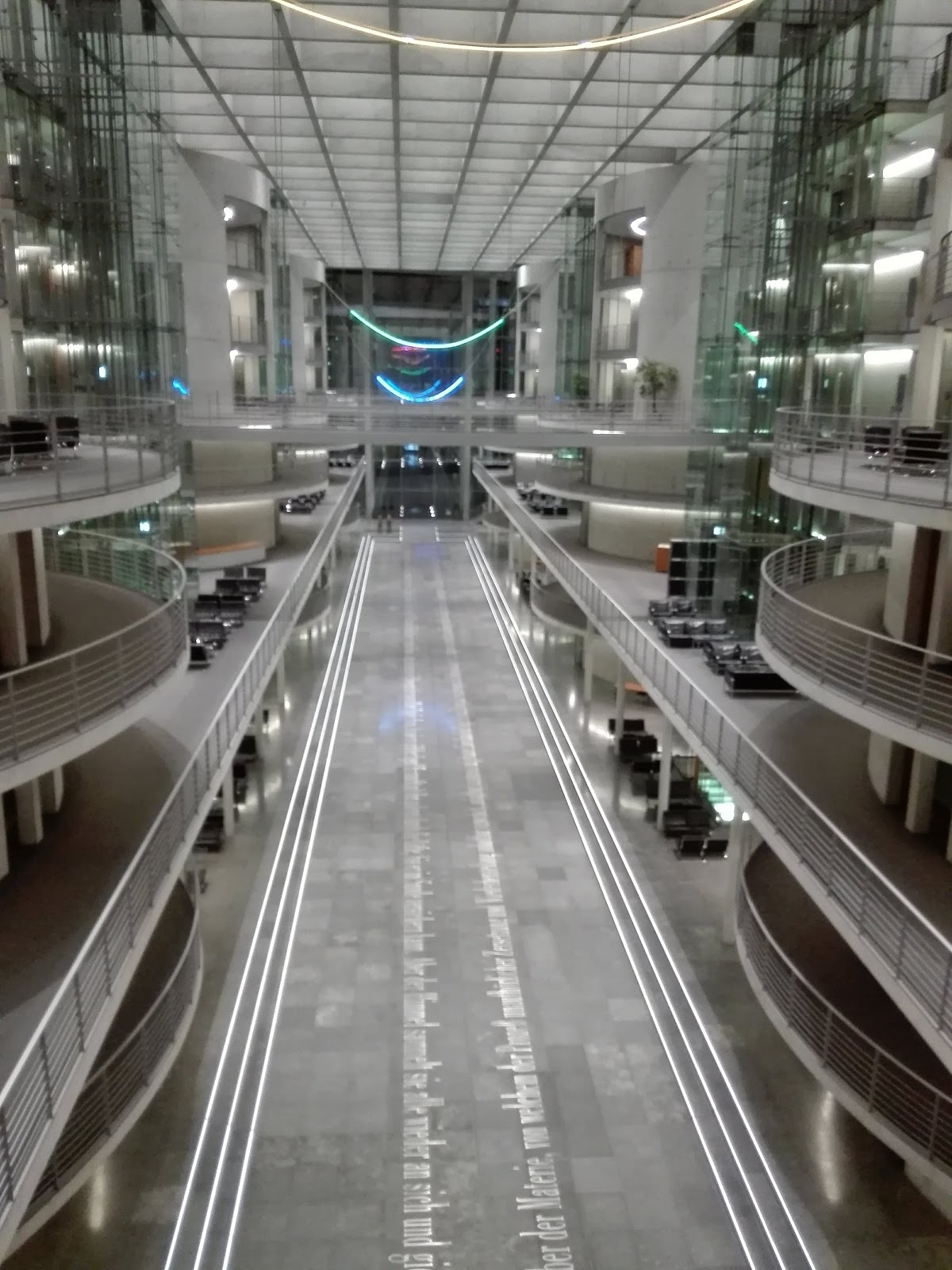
Le architetture moderne del Bundestag.
Non è mancata la parte turistica. Berlino è talmente grande e mutevole che c'è sempre qualcosa da vedere. Questa volta mi sono concentrata su Tempelhof, il Bundestag e lo shopping della domenica. Con ordine, Tempelhof. Si tratta del vecchio aeroporto cittadino, attivo dal 1923 al 2008, ora trasformato in un enorme parco. In una giornata fredda e grigia, come tipico a Berlino, vi ci sono andata con la collega turca, tra l'altro raffreddata, poveretta, facendole fare km e km a piedi. Atmosfera magnifica. Architettura degli anni '30, enormi spazi vuoti circondati da dense aree residenziali, gente di ogni età, origine e ceto a trascorrere il tempo camminando, facendo volare aquiloni, correndo, allenandosi sui pattini, etc. Un posto particolare che merita una visita per comprendere meglio l'anima della città. Questo aeroporto ha visto una guerra mondiale, il ponte aereo per salvare Berlino Ovest durante la guerra fredda, la riunificazione della Germania fino alla recente crisi dei rifugiati. Il Bundestag. Grazie ad un'amica e compaesana della collega tedesca che qui lavora abbiamo avuto modo di visitare il complesso di edifici del Bundestag. Architetture moderne geometriche e simboliche perfettamente integrate con quelle storiche restaurate del vecchio edificio del Reichstag. Installazioni artistiche moderne che portano a riflettere. Mi ha fatto una certa impressione visitare il Parlamento tedesco senza mai aver visto Montecitorio (nemmeno da fuori) o quello austriaco (tra l'altro al momento chiuso per lavori di restauro). Infine, lo shopping della domenica. Per puro caso, questa domenica molti negozi erano aperti nel pomeriggio. Effettivamente Berlino costa meno di Vienna, non a caso ho comprato qui parecchi articoli per la casa e di abbigliamento negli anni passati. La ciliegina sulla torta è stata la tradizionale torta col caffè al ristorante sul tetto della Galeria Kaufhof ad Alexanderplatz. Un piccolo lusso alla portata di tutti.

Berlino resta uno zoo in cui ogni sorta di specie convive pacificamente con l'altra. Forse solo a Londra si osserva una fauna simile, con la differenza che Londra è fossilizzata nella sua storia gloriosa (come Vienna) mentre Berlino ha dovuto ingoiare più volte lacrime amare per poi rinascere guardando avanti. Berlino non è bella, solo alcuni palazzi meritano la definizione di belli, non so se sopravvissuti ai bombardamenti o interamente ricostruiti (come stanno facendo ora col castello prussiano). Non è nemmeno una brutta città industriale con le periferie raffazzonate negli anni '50 come Glasgow. Nonostante le diverse stratificazioni, la massiccia ricostruzione nel dopoguerra ed i 40 anni di regime socialista, Berlino non ha nemmeno quell'accozzaglia di edifici brutti e sporchi che soffocano delle vere perle come a Bruxelles. Insomma, Berlino ha una sua anima che non si può ritrovare altrove. Non a tutti piace, merita comunque una visita.

Saturday, June 17, 2017

Berlin and Italian scientists abroad

It is written. At least once a year, I must go to Berlin. Doesn't matter where I am, Vienna or Brussels, Berlin waits for me. The reason of the journey might be different: a conference, a cooperation, some instrumental analyses, a job interview, a class, etc. Sometimes the final destination was Potsdam, not Berlin, once it was Dresden, but I flew anyway to Tegel. This year I went to Berlin for giving a talk at the Natural History Museum. It was the fourth time in such an event. As the day after my talk was a holiday in Austria (Corpus Domini), but not in the Lutheran part of Germany, I decided to stay one day longer in Berlin, just to enjoy the city.

500 yrs after the Reformation
I do like Berlin. There are many features that make this city unique. Such as the smell of railway in the underground stations, the kindness of the local people, the feeling of continuous activity in a place that seems never to sleep, the quietness of the house blocks, the abundant gardens, the signs of the recent history, etc. Nevertheless, for the first time I felt happy to go back to Vienna after this short visit, saying to myself "finally at home". Berlin has been my dream place for years, but now I'm happy where I am. I don't wish to change. It means that I love to go to Berlin, but I don't blame the destiny for not having gotten a job there. It was not written, probably. I felt "Austrian" during my stay because people had fun of me due to my accent (thanks Vienna! very likely also the grammar mistakes in German have contributed to this impression) and because during the mass I recognised some Austrian church songs. By the way, even though the songs where austrian and 100% catholic, the speech sounded quite lutheran. It's Berlin. Like the well developed public transit network: mostly trams in the former eastern part of the city and mostly underground in the former western part.

Berlin wall memorial.
Italians everywhere! Also in our institute, in Vienna, the Italian community of post-docs is growing. In this case, people from Padova everywhere, or better, in Berlin. Some years ago, I met here a schoolmate of the time of the university, a paleontologist, who was forced to leave Italy with his wife to stay in science. Now he works in Switzerland. But his presence has been "replaced" by an astrophysicist from Padova, a girl who did her PhD in cooperation with a professor of mine and who also was used to play the organ in the church. I was happy to meet her in Berlin, to spend some time with a friend, to talk again about the typical parish life in Padova, and to meet also her mother. On the other hand, I was sad realising that she had to leave Italy, too. She's brilliant, she won a Marie Curie grant.  Italy doesn't change. Italy spends a lot of money to train good scientists and then lets them leaving, bringing European money to other nations, increasing the publication rate of foreigner institutes, being exploited for what they can offer. This is the point. We cannot go back, but we have a few chances to stay where we are. When a permanent position is available, a local is preferentially hired, perhaps someone who has spent years abroad, for a better training. Hiring someone with another nationality is too demanding in terms of bureaucracy, language, and mentality. We are trapped. Like behind an ideal wall, we cannot stay, we cannot go back. We can just live the instant.

Saturday, April 29, 2017

EGU, 10 anni dopo, vecchie e nuove generazioni di geologi

Questa settimana non ho avuto un momento di respiro, nonostante... non abbia partecipato attivamente all'assemblea annuale della EGU (unione europea di geoscienze). L'ultima volta che vi presentai qualcosa, non contando un poster clandestino nel 2012, fu nel 2007, quando ci venni con i colleghi del dipartimento di geologia (allora si chiamava ancora così, ora dipartimento di geoscienze) dell'università di Padova. Durante il mio primo post-doc a Vienna ero costantemente fuori città in questo periodo, o a Berlino per lavoro o in Italia in vacanza. Quest'anno non mi sono mossa e quasi ogni giorno ho avuto un pranzo e/o una cena con ex-colleghi, che mi hanno ricordato quanto accaduto in questi dieci anni.

Sabato sera ho rivisto tre degli ex-dottorandi di Vienna, ossia una ragazza polacca che ora si è stabilizzata in Polonia con il marito, un americano, che era venuto anche a Bxl ed ora fisso in Sudafrica con la moglie russa, anche lei geologa e con un dottorato a Vienna, ed un austro-ungherese astronomo che è rimasto in città. Mancava solo un altro astronomo veneto, che dopo due anni in Canada è tornato a Vienna per un anno. Gli altri ex-dottorandi di quel gruppo, arrivato nel 2010 come me, se ne sono andati dopo circa un anno. Si trattava di due italiane ed un tedesco, che poco dopo aver lasciato la città hanno trovato lavoro nel privato nei rispettivi paesi o altrove.

Domenica ho cenato con ex-colleghi pisani, tra cui un amico che vive da anni a Vienna e lavora(va) nel privato, un geologo che vive e lavora in Scozia e che conobbi prima ancora di laurearmi ad un corso a Basilea ed una geologa che solo ora è riuscita a rientrare a Pisa dopo aver trascorso anni di ricerca in Alaska, Sudafrica e Brasile. Abbiamo ricordato i vecchi convegni ove ci siamo conosciuti, le bevute assieme, i nostri ex-capi, i corsi a Perugia, etc. ossia i tempi in cui io iniziavo a conoscere il mondo accademico mentre loro, già con qualche anno di esperienza, me ne mostravano gli aspetti positivi. Con gli anni ho scoperto da sola quelli negativi, ad averli conosciuti subito forse non avrei intrapreso questa strada, nonostante l'entusiasmo non sia mai venuto a mancare.

Lunedì sono rimasta in ufficio, organizzando gli incontri dei giorni successivi. Martedì ho pranzato con gli ex-dottorandi viennesi del mio gruppo, quelli del sabato, ma cui si sono aggiunte anche l'attuale dottoranda turca, che lavora al convegno, e la moglie russa del collega americano, che ha svolto il dottorato su campioni provenienti dallo stesso affioramento su cui feci il dottorato e con cui ho amabilmente discusso di possibili future collaborazioni. A sorpresa ho pure rivisto un collega belga, da anni a Brema per un post-doc.

Mercoledì ho pranzato con un ex-compagno di università, ora a Roma, che ha sposato un'altra compagna di corso. Siamo scappati dal caos della zona convegno per poter conversare tranquillamente al sole, di fronte all'alte Donau. Tra aggiornamenti reciproci, idee per possibili collaborazioni e l'immancabile confronto Italia-Estero le ore sono volate. Dopo cena ho rivisto un amico di lunga data, ex-collega di Padova, venuto al convegno quasi senza preavviso e solo per un giorno.

Giovedì ho cenato con gli ex-colleghi dal Belgio, che avevo già visto velocemente martedì. Due di loro, un dottorando belga fiammingo ed uno di origine olandese, sono venuti un po' prima all'università, così hanno potuto vedere dove lavoro ora. Per cena ci ha raggiunto anche un dottorando brussellese e ci siamo lasciati solo dopo un numero appropriato di allegre chiacchiere e di birre austriache. Nonostante questi ragazzi lavorino su argomenti molto distanti da ciò di cui mi occupo, abbiamo legato a Bxl grazie ai numerosi pranzi assieme in mensa ed un'escursione in Baviera. La vita sociale dell'università resta uno dei pochi ricordi piacevoli della permanenza a Bxl.

Venerdì ho iniziato con la colazione con l'ex-collega pisana di domenica, per un ultimo saluto prima di chissà quanto, visto che l'ultima volta che c'eravamo viste risale credo all'autunno 2010 a Padova. Dopo un seminario di un ottimo ricercatore inglese che lavora a Padova (rarissimo caso di emigrazione al contrario...), per pranzo mi ha raggiunta un'ex-dottoranda triestina che aveva lasciato Vienna anni fa per iniziare una brillante carriera accademica nella sua città. Mi ha confermato l'effetto straniante nel tornare in questo posto, che non muta mai ed è fuori dal resto del mondo e dalla realtà.

Finalmente l'EGU è terminato. Per incontrare alcuni degli amici sono andata alla sede del convegno, ove lavoravano colleghi ed ex-colleghi dell'università di Vienna, quindi saltavo dall'inglese al tedesco e all'italiano in continuazione. È stata una settimana intensa. Per caso non ho rivisto alcune persone del mio passato accademico che preferivo non rincontrare (credo sia un sentimento reciproco, visto che non mi hanno cercata, pur sapendo che sono in città), non solo italiani. Al contrario, mi ha fatto molto piacere rivedere così tante persone, conosciute negli anni ed in giro per l'Europa. Spero di essere stata per i più giovani di loro quello che i più anziani sono stati per me all'inizio del dottorato ed ai primi convegni. Ognuno vive questa esperienza in modo diverso, ma sono più le persone che incontriamo che ci fanno crescere di quello che ci viene insegnato sulla materia.

Saturday, August 13, 2016

Berlin reloaded

Going again to Berlin from Vienna. Like the "old good time". It's for attending an international conference that I tried to avoid until the last minute. Why? Because the chosen logo closely recalls a nighmare I had as a child, with a meteorite hitting Berlin. Because the expenses are not covered by any grant, so except for the registration fee, reimbursed from Brussels, the costs for journey and accommodation are on me. Because I don't like much this conference, where I shall have to smile to colleagues who in the past have sent nasty personal comments, to envy competitors, to old professors who 'did this stuff already forty years ago' or 'this is bullshit, you understand nothing of the subject', and where public relations and politics are often more important than science. There is also good science, but mixed with hypocrisy. I'm not very good at that. I'm too honest, not to say what I think. Luckily this is going to happen in Berlin, a city I love (in a different way from Vienna, as always said) and I'm looking forward to meeting the local organising group, the international-Belgian team I've just left, some of the old colleagues from Padova, former and new colleagues met in Austria (almost none of them is Austrian, though) and a few outstanding scientists, whom I feel honoured to talk with.

The metro to the conference venue
Weekend
The arrival has been adventurous as always, with my flight being delayed, initially one hour for late arrival of the aircraft and then one further hour due to a storm over the airport. Luckily the guy at the ho(s)tel waited for me. The guest house where I stayed, a very cheap one in Wedding with (gender separated) shared bathroom, is rather old, simple and essential, overall quite clean. The only thing I didn’t like was the noisy and dirty neighbourhood. OK, it’s Wedding, but the double windows (not double glazing) could not stop the noise from the night clubs or the road. However, even going for food in a turkish place after 10 pm, despite being the only woman around, was pretty safe. It's Germany.

The reason for my arrival on Friday night is a 2-days workshop organised over the weekend. The conference venue is the Henry-Ford-Bau, a beautiful building in a nice area, but that requires 45-50' journey to be reached from where I stayed. The workshop has been overall interesting parts, with insightful comments and feedbacks, even though some 'political' scary moments occurred. The food and the drinks for the coffee breaks and the poster session were delicious and overall the people I talked with very pleasant. 

After the Sunday morning session, I even managed to attend a kind of organ concert, as told here. In the afternoon, I was joined by most of the Belgian team, which I already miss a lot, and we moved to another hotel in the heart of Friedrichshain. We went together to the icebreaker party in the Museum für Naturkunde, enjoying the exhibition, meeting old friends from Padova, Camerino, Vienna, Berlin, Freiburg, Sweden, USA, etc., tasting surprisingly good cucumber ice cream, and generally mixing talks about science with gossips and rumours.

The week
I won’t tell here the good and the bad science I’ve heard. Nor I’ll tell about new ideas and projects, turns of mind, political games and fairness, heavy criticisms and insightful suggestions. It was the usual old MetSoc, a conference that I don’t like much but that I cannot avoid to attend. Not only it is important for my current research, but it is also fundamental to build that network that might help to get the next job position. Every year it is held in a different city, two years ago it was in Casablanca (never more to Morocco!), next year it will be in Santa Fe, then in Moscow (really?), Sopporo, etc. Who knows how many other MetSoc I will attend! As long as I stay in the field and I have money for the registration and the journey…

The guy who invented the microscope
On Wednesday, I didn’t join for the award ceremony, as well as for the city tour. I decided to go to shopping instead, together with a couple of old mates known during the university years. In the evening, we had the banquet. The location was amazing (Wasserwerk), the food was delicious, but the disco music towards the end was too loud. I was literally shocked by seeing old professors making a fool of themselves. Luckily not those I like the most. A Belgian colleague was tired as well and shortly before midnight we headed to our hotel.

Back to science, I must admit that twice I felt acknowledged: when what I presented at the MetSoc in 2012 and wasn’t believed has been mentioned and cited and when at the break after my talk (not my best work ever, I know) I received positive feedbacks, great suggestions to improve, and expression of  interest, even though it looked ignored just after the presentation. I shouldn’t give up.

Goodbye Berlin
Again. I cannot remember how many times I had to say 'goodbye' to friends and colleagues, and most of all to this city. It’s difficult to describe Berlin. Even though I saw it a bit more dirty and international than previously, I still cannot avoid to be deeply in love with it. The journey back to Vienna has been perfect. Super connections with three different public transportations to the airport, light rain at the departure, arrival largely in advance, and fast drive to my place with a taxi. A bit of luxury that makes me feeling professional. The very next step is to achieve all the good plans I had during the conference. Let's begin posting this report.


Monday, December 7, 2015

Ich werde mal wieder “Servus” sagen!

La settimana scorsa è stata particolare. Sentivo qualcosa nell’aria, ero nervosa. Davo la colpa al caffè (istantaneo e diluito) ed al tè verde. Un giorno, al ritorno dal lavoro, ho sentito l’impulso di scendere ad una fermata prima di quella solita e fare un tratto a piedi. Sono passata davanti ad una chiesa che non avevo mai visitato. Presa dalla curiosità di vederne l’organo e trovando la porta aperta sono entrata. Il tempo di una preghiera, nel buio della navata principale, all’ombra dell’imponente organo e con il tabernacolo illuminato. Poi sono tornata a casa al solito. Nulla accade per caso.

Nella buca delle lettere c’era una lettera dall’università. Era l’avviso di licenziamento. Niente di drammatico. La legge belga prevede che un contratto a tempo determinato si possa rinnovare una sola volta, per cui ad aprile dell’anno scorso ho firmato un contratto a tempo indeterminato, pur sapendo che quando i fondi sarebbero terminati avrebbero dovuto licenziarmi. Così è stato, mi danno il preavviso di sei mesi. Bene! Ho pensato, così possiamo programmare la data per l’inizio dell’altro progetto, già finanziato, che mi permetterà di restare a Bxl per due ulteriori anni.
Ho fatto fatica a prendere sonno e poco prima delle 23 mi sono svegliata. Mi sono riaddormentata ed ho ronfato, sognando un esame, fino alle 7. Una volta tanto non solo non mi sono svegliata alle 6, ma non ho nemmeno sentito la sveglia impostata sulle 6:30 automaticamente. Faccio colazione e controllo la posta. elettronica Ed ecco LA NOTIZIA. Ancora non ufficiale, giusto un anticipo dal mio ex-capo. Il progetto mandato a Vienna sei mesi fa è stato approvato! Non ci posso credere, non può esser vero. SI TORNA A VIENNA!!!! GRAZIE, SIGNORE!!! Ho tenuto la cosa per me fino all’arrivo della conferma ufficiale e solo oggi ho comunicato la notizia ai miei capi ed ai colleghi.

Ci vorrà tempo, penso di prendermi tutto quello necessario. Mi voglio godere ogni istante. Non mi sposterò prima di sei mesi almeno. La responsabilità di un progetto da me scritto mi spaventa un po', anche se per la mia carriera questo finanziamento è un ottimo salto in avanti. Ma solo l’idea che potrò lasciare Bxl per tornare a Vienna mi rende felice. Sì, mi mancheranno incredibilmente le persone incontrate qui. Rimpiangerò i colleghi ed i miei capi, che sono diventati degli amici più che dei superiori, tanto da aiutarmi nel trasloco o dal condividere anche questioni personali. Mi mancherà la variabilità meteorologica quotidiana (ma non la totale assenza di stagioni). Non inizio la lista di quello che non rimpiangerò perché sarebbe ingiusto. Bxl, nonostante tutto, mi ha dato molto. Ho imparato parecchie lezioni, non solo dal punto di vista scientifico, ma soprattutto per la vita. Non sono la stessa persona che tre anni fa lasciò Vienna per venire qui e sicuramente la città che troverò sarà differente da quella ricordata. O forse no, perché Vienna è congelato, meglio, fossilizzata nei fasti del passato imperiale. 

Difficile a credersi. Anche questa è Vienna.
Cosa ritroverò? Le passeggiate in bici lungo il Danubio e le pedalate in notturna in città dopo le serate con gli amici. Il buffo accento viennese e le parole alternative che si usano lì (Jänner per Januar, Erdäpfel, Marillen, Melanzani, etc.). L’opera ed il Musikverein a prezzi stracciati per posti in piedi ma con interpreti internazionali. Le giornate in un ufficio che assomiglia ad un ospedale psichiatrico (non solo esteticamente), rimanendo lì fino a notte fonda, anche nei festivi, ma sapendo che nel caso non avessi nulla in casa potrei sempre ricorrere al turco ad ogni stazione della metro. Il suonare in chiese diverse ogni domenica con organi scomodi, enormi (4 tastiere per me sono tante), elettrofoni e tastiere, tutti in cantorie buie, lottando con il telecomando per proiettare i canti. La burocrazia asburgica, kafkiana ma efficiente. I viaggi in treno per tornare a casa in Italia, con il notturno attraverso Tarvisio o lungo tutta l’Austria per arrampicarsi al Brennero. La bellezza degli edifici lungo il Ring. L’insofferenza per lo snobismo dei locali, il razzismo latente e la totale mancanza di memoria storica. Il Mohnstrudel al mercatino di Pasqua di Freyung, tra le migliaia di uova decorate, il Glühwein con le tazze da collezione per Natale, i Krapfen ed i balli per carnevale (rigorosamente dall’11 novembre), l’oca di San Martino e la festa della zucca. La metropolitana ogni 3-4 minuti e pure durante l’intera notte nei weekend. I caffè storici ove è possibile leggere un giornale, sorseggiando un melange e gustando una fetta di torta, mentre il vicino (sigh!) fuma. Il breve tragitto in S-Bahn per raggiungere l’aeroporto, passando in fianco al cimitero centrale e alla pulitissima raffineria dell’OMV. I parchi. Grinzing e la foresta viennese ove andare a passeggiare. L’imponente e tranquillo Danubio…

Ritroverò anche alcune persone con cui non ho mai interrotto i contatti. Altri prima di me hanno lasciato la città, ma alcuni sono rimasti. Anche loro saranno cambiati in questi anni. C’è qui ha avuto un figlio, chi ha trovato un nuovo lavoro, chi ancora ritorna dall’esilio come me. E poi ci saranno nuove conoscenze.

Non credevo sarebbe mai stato possibile, ancora fatico a convincermi. È vero! Bis bald, Wien!

Friday, November 20, 2015

Japan 4.0

4th time in Tachikawa, again for a symposium and in the framework of the successful collaboration between Japan and Belgium. A full experience, as always. This post will be partly in Italian, because some ideas would be too difficult to be expressed in a foreign language and because these thoughts are mostly of interest for my Italian friends.

Journey
Outbound Flight with Austrian and inbound with Lufthansa. It is was a very cheap combination, but extremely agreeable. A bit of nostalgia had hit me by seeing again pictures of Vienna and listening to Strauss’ music, as every time I board an Austrian plane. It didn't last long, though, because the usual manners of the flight attendants and the meals offered on board have reminded me what I did not like of Vienna. I had a tight connection in Vienna, but luckily the flight had 2h30 delay. On the way back, flying with Lufthansa, I was more comfortable. It is always a long flight (about 12 hrs to reach Europe) and I get easily bored, I don't sleep much, especially when my neighbor is snoring... Now there is a direct flight connecting Brussels with Tokyo, but it is still too expensive.

Religiosity
On the way to Tachikawa from Narita Airport, on the train, I met another Italian (I know, we are everywhere and we recognize each other immediately). This fortunate meeting offered me the opportunity not only to discover a part of Tachikawa I didn't know, but also to think about religions and the way we deal with them. (The following two paragraphs are in Italian).

La ragazza incontrata è un monico buddista ma anche una cattolica osservante, ossia ha abbracciato una filosofia di vita ed un cammino spirituale di tipo buddista che non solo non sostituisce ma addirittura sostiene la fede individuale, tanto che tra i suoi amici ci sono anche ebrei e musulmani. In sostanza, il buddismo da lei praticato non costituisce una religione a sé stante, ma un percorso filosofico. Ho visitato un tempio molto importante per questa scuola e lei pazientemente mi ha spiegato il significato dei vari riti. Il mio approccio alla religione, forse più “luterano” per certi aspetti che “cattolico”, ossia con dubbi, domande e ragionamenti (non ho mai amato il dogmatismo) non è cambiato, ma la sua esperienza mi ha fatto riflettere sul fatto che per lei il buddismo ha avuto la stessa funzione che per me ha la musica sacra. Il cammino è importante tanto quanto l’arrivo, perché la nostra vita non è altro che un lungo percorso verso una destinazione che forse mai raggiungeremo, ma che vediamo solo con la Fede.

Sinceramente consiglierei una chiacchierata con questa ragazza a tutti i miei amici estremisti, sia quelli tradizionalisti cattolici sia quelli rabbiosamente atei. Entrambi potrebbero imparare che la pace e l’amore fraterno risultano dal rispetto per il pensiero altrui. Rispetto significa anche interesse, perché c’è sempre da imparare e motivo di crescita. Sono onestamente stufa di moniti per le frequentazioni non strettamente cattoliche da una parte e commenti irrispettosi verso i credenti dall’altra. A tal proposito, vorrei ricordare che criticare l’istituzione è lecito, ma non deridere chi crede (o non crede), di qualsiasi religione si tratti!

Japanese style
Back to English, for something that has never happened before. On Sunday morning I overslept, despite the alarm! I was tired for the flight, but I always woke early. This time I almost missed breakfast in the hotel, after sleeping for about 12 hrs!

The Japanese experience has been dominated by food this time. From the traditional tea shop where the owner has explained with drawings the different varieties of tea, to the traditional restaurant for the final dinner offered by our Japanese counterpart, where four cooks were there only for us and we ate the famous fugu (puffer fish, pesce palla, lethally poisonous if not cut as it should). In between we had a delicious (after party) dinner in another restaurant, with a lot of food and sake, with Japanese professors and their students, heartily laughing and seriously discussing about science like in any corner of the world when among geologists. We had also a funny experience with a shabu-shabu place, due to the complicated order in Japanese. It is extremely difficult to communicate with locals, because even the gesture is quite different from the european style.

Science
The reason for the journey was the annual symposium on Antarctic meteorites. Scientifically very interesting for both sides, even though a very few foreigners attended it. After the symposium, those of us in the established collaboration between Japan and Belgium had a private meeting to discuss the future of the collaboration and the strategy for investigating the samples we have. I must admit that my mixed Italian-German dedication to science is sometimes in contrast with the complex way of dealing with problems typical of Japan or the Belgian easiness.

Actually, I was a bit surprised when my boss proposed to extend my stay in Japan for a couple of days. I said no, firstly because I had already other commitments in these days in Brussels and secondly because scientific research is not more important than my life (it took a long time, but now I’ve learned). I’m always happy to work on Sundays or bank holidays, I’m flexible in changing my plans if possible, but not when I’m on the other side of the Earth, just the day (less than 24hrs) before the planned flight (booked months in advance). I love my job, but I’ve already given up too many times things that I love as well, just for prioritizing  (sometimes) useless tasks. The fact that I don’t have a husband and children waiting for me at home does not imply I don’t have a life outside the office. I thank my other boss, another woman in science, for having understood my point and having supported my "no". 
 
Paris and Brussels

Finally some thoughts on what happened in Paris on Friday 13th. I read the news only upon arrival in the hotel. Initially shocked for what they dared to do, then for the reaction. I don’t think that further violence is the best answer to a similar attack in the heart of Europe. I don’t think that religion has something to do with the behavior of terrorists. I don’t think we should restrain from living normally because of fear. Death comes always unexpectedly, for a bunch of causes. An increase in security check is due (like I saw at Frankfurt airport), similarly to our regular health checks, but cancelling events such as football matches or concerts is a bit too much in my opinion. However, I do find a bit weak the general behavior of Belgium with respect to the issue.

The reaction of Japanese people was also surprising. A colleague, temporary in Belgium, was reconsidering the idea of coming back. The lady at the airport desk asked me about Brussels, as she thinks that the place is not particularly safe in this moment, but she should come for working. I indeed consider Brussels not particularly safe in comparison with other european cities, but for completely different reasons (crazy driving style, number of thefts, rapes, etc.). If we consider natural disasters and even terrorism, Japan might appear even more dangerous.

In conclusion, even though the cultural difference is a bit shocking and the journey extremely tiring, I'm happy to come back to Japan whenever possible!

Sunday, January 26, 2014

What italian emigrants do

Recently an italian newspaper hosted a debate about what italian emigrants do.
According to Matteo Cavezzali, who lives in Italy:
1. They go out only with other Italians.
2. They know everything about italian politics, especially about Berlusconi, even if they emigrated because they were sick of him.
3. They miss the italian sun, because they live in cold and gray countries, but they don’t want to admit it.
4. They eat bad, they look for good italian restaurants but they cannot find one.
5. They have jobs that in Italy they would have never accepted.
6. They cheat (e.g., don’t pay the bus ticket) and they forget to pay taxes.
7. They dislike going back to Italy, even for a short trip, because they feel superior.

The reply by Andrea D’Addio, who lives in Berlin, was:
1. They do not wash their car because they use public transportations or their bike.
2. They miss the sun and they do poor jobs, but the working conditions are much better than in Italy and they can pay for luxury vacations in sunny countries.
3. They generally eat at home, cooking by themselves, but they also try exotic restaurants.
4. They go out mostly with other Italians, but they work in an international environment. Their friends are true friends and the nationality doesn’t matter.
5. They try to build their own family because the host nation helps families, although the salaries might be not that high.
6. They follow the italian politics because they care about their country. When they are asked about Berlusconi, they want to give a good answer.
7. They don't envy who remained in Italy. They know how difficult is leaving friends, family and country for going in a hostile place, so they hope one day to go back to Italy.
Ovviamente non possiedo alcun diritto sull'immagine. Italia, è questo che pensi di noi?
Somehow Matteo and Andrea are both right.
- I go out with other Italians but also with international colleagues. My friends are from different nationalities.
- I always read the italian news, but also those of host country. News are filtered before being published abroad, I can have a different point of view than while I was in Italy. I’m sick of questions about B., I don’t have an answer.
- In Brussels I don’t cook at home as often as I was used to do in Vienna, but I still cook when I invite friends to my place for a dinner. Many other (not only) Italians do the same. I must admit, I like enjoying a restaurant sometimes. I try italian restaurants (often suggested by Belgians) but I prefer local restaurants or very exotic ones. During my stay in Japan, I didn’t miss the italian food, I loved eating japanese, even when I didn’t know what I had in the dish.
- Honestly, I never complain for the temperature. I don’t miss the “italian sun” because I grew up in a foggy and gray part of Italy. I like even the rain. Probably I’m the only Italian who says that.
- I was lucky, I got the job I like, with a position consistent with my qualification. Other italians weren’t that lucky, unfortunately, but the foreign governments usually help unemployed people.
- I’ve always payed my duties, in Italy and abroad. The honesty was part of my education, if italians behave bad, they should blame their parents.
- I dislike going to Italy because I feel bad for my country. The comparison with other countries is sad, the solution to many problems is much closer then expected… if only we would be able to look to the problem from another point of view

Disclaimer: I might have misinterpreted Matteo and Andrea's opinion in the attempt to translate. This is my interpretation of what they have written.