Friday, April 25, 2014

At home?

After 4 yrs living abroad and a recent relocation to a new apartment, I wonder how much do I feel to belong to a place. Or better where do I feel at home. What do I mean when I say –I’m going home— the place where I currently live or my parents’ house?  Four yrs might have been enough to make me feeling a beloved guest during my visits in my hometown, although I spent there about 30 yrs of my life.

The reasons why I don’t feel at home in my hometown in Italy come from the past. When my parents decided to move back to Italy from Germany, I went to the nearest kindergarden, but I’ve never been considered a “local” by my schoolmates. Only recently a couple of mates have greeted me as “back home". For sure, in my parents' house I feel as I’ve never left, but I've never considered to move back there, unless forced by events. I don't feel my hometown “my place”.

Vienna is the most comfortable place where I've lived and I miss a lot the life I had there. Although I miss the concerts, the churches, the gardens, the food (especially the Mohnstrudel), and the beauty of Vienna, I know that I don’t belong to that city. It was really nice to live there. It was like a dream that cannot last forever, after a while becomes unbearable. In addition, I had a flat in a student dorm, not the place one would consider "home".

At the beginning Brussels reminded me the worst of Padova. In summary: the traffic jams, the slowness of bureaucracy, the scarce care to customers in shops, the frequent frauds, the petty crimes, the insufficient public transportation, etc. The first 6-8 months I deeply hated this place. Then I found a kind of agreement for surviving. Finally I moved in another area and it seems I moved in another continent. Although now I feel that I could stay here for the rest of my life, I know that also this solution will be probably as temporary as Vienna, because of my job.

Anyway, wherever I move I always feel a foreigner. The main problem is the language, in my hometown I didn't speak the local dialect, in Vienna proper Wienerisch (not even decent German), in Brussels I'm fighting with terrible English, a bit of Dutch and pretty bad French. What will come next? Erasmus, who lived in town, said  that home is where the hearth is. My brain is in Germany, my stomach between Italy and Austria, but I liked also a lot Japan, although my hands would prefer Swiss organs,...  I’m afraid my hearth has still to find its place.

Sunday, January 26, 2014

What italian emigrants do

Recently an italian newspaper hosted a debate about what italian emigrants do.
According to Matteo Cavezzali, who lives in Italy:
1. They go out only with other Italians.
2. They know everything about italian politics, especially about Berlusconi, even if they emigrated because they were sick of him.
3. They miss the italian sun, because they live in cold and gray countries, but they don’t want to admit it.
4. They eat bad, they look for good italian restaurants but they cannot find one.
5. They have jobs that in Italy they would have never accepted.
6. They cheat (e.g., don’t pay the bus ticket) and they forget to pay taxes.
7. They dislike going back to Italy, even for a short trip, because they feel superior.

The reply by Andrea D’Addio, who lives in Berlin, was:
1. They do not wash their car because they use public transportations or their bike.
2. They miss the sun and they do poor jobs, but the working conditions are much better than in Italy and they can pay for luxury vacations in sunny countries.
3. They generally eat at home, cooking by themselves, but they also try exotic restaurants.
4. They go out mostly with other Italians, but they work in an international environment. Their friends are true friends and the nationality doesn’t matter.
5. They try to build their own family because the host nation helps families, although the salaries might be not that high.
6. They follow the italian politics because they care about their country. When they are asked about Berlusconi, they want to give a good answer.
7. They don't envy who remained in Italy. They know how difficult is leaving friends, family and country for going in a hostile place, so they hope one day to go back to Italy.
Ovviamente non possiedo alcun diritto sull'immagine. Italia, è questo che pensi di noi?
Somehow Matteo and Andrea are both right.
- I go out with other Italians but also with international colleagues. My friends are from different nationalities.
- I always read the italian news, but also those of host country. News are filtered before being published abroad, I can have a different point of view than while I was in Italy. I’m sick of questions about B., I don’t have an answer.
- In Brussels I don’t cook at home as often as I was used to do in Vienna, but I still cook when I invite friends to my place for a dinner. Many other (not only) Italians do the same. I must admit, I like enjoying a restaurant sometimes. I try italian restaurants (often suggested by Belgians) but I prefer local restaurants or very exotic ones. During my stay in Japan, I didn’t miss the italian food, I loved eating japanese, even when I didn’t know what I had in the dish.
- Honestly, I never complain for the temperature. I don’t miss the “italian sun” because I grew up in a foggy and gray part of Italy. I like even the rain. Probably I’m the only Italian who says that.
- I was lucky, I got the job I like, with a position consistent with my qualification. Other italians weren’t that lucky, unfortunately, but the foreign governments usually help unemployed people.
- I’ve always payed my duties, in Italy and abroad. The honesty was part of my education, if italians behave bad, they should blame their parents.
- I dislike going to Italy because I feel bad for my country. The comparison with other countries is sad, the solution to many problems is much closer then expected… if only we would be able to look to the problem from another point of view…

Disclaimer: I might have misinterpreted Matteo and Andrea's opinion in the attempt to translate. This is my interpretation of what they have written.

Saturday, January 18, 2014

Christmas-vacation tales

Preface
Although I’m clearly not skilled in foreign languages, I try to do my best. I’m not even perfect in Italian, which is my mother language. I have the feeling that even my English is worsening since I moved to Brussels, but now I’m able to say a couple of sentences also in bad French and Dutch. Thus, I’ll keep writing in English, because this is a way to practice and because I believe the content is more important than the syntax. Well, who cares of a personal blog? Me. That’s enough.

In 2014 I celebrate some important anniversaries:
- 15 yrs from my high school diploma
- 10 yrs from my Ms in Geological Science
- 10 yrs since I moved to live by my own
- 6 years from the publication of my first scientific paper
- 5 yrs from my first overseas flight (to San Francisco)
- 5 years from my PhD

As 10 yrs ago
As usual, I've spent a couple of weeks in my hometown. This year, as previously, I’ve organized a dinner with my university mates. Although some of them couldn’t join us, we were 12, with at least half of us at “home” only for Christmas, after having migrated abroad for a job. Only a few of us still work in Italy, but almost all were able to stay in the field.
This dinner was as entertaining and funny as 10 yrs ago. During the dinner we planned the next meeting, possibly in summer, to celebrate 10 yrs from graduation with a whole weekend together, included a field trip on "our" mountains. Can't wait!

No snow…
My wish was enjoying a white Christmas in the mountains, but... Despite the weather forecast had called heavy snowstorms, in our area we didn’t see a single snowflake! Only rain or thick clouds. Although I like the rain and I love the cold air above 1000 m a.s.l., I couldn’t cope that sad atmosphere longer than a couple of days, so I asked my parents to go back to the foggy and warm plain. Nevertheless, it has snowed in other areas of the Italian Alps, causing an electrical black out that lasted more than four days. That’s Italy. Back to 100 yrs ago in a minute. What a time machine!

… no party
I was used to spend the New Year’s Eve with some friends from the Conservatorium, at my place or at a cellist’s place, having a lot of fun playing music together and baking italian traditional food. Not this year. Perhaps because I’ve lived abroad too long. Also the President, in his New Year's Eve speech has forgotten all the Italians living abroad. Are we still italian?
Anyway, this year I’ve spent the New Year’s Eve at home, watching an old movie, playing cards, sleeping, etc. as an old spinster. Not because I stayed at home, but because there wasn't a partner next to me. This year less noise came from my neighbors, maybe less money to waste and sadder mood, what is called crisis.

Chatting with old friends
Obviously I worked while at home, I played a lot as well, both organ and piano. But this is has been also the time for meeting people I see once a year or that I didn’t see for years. This is like meeting the past and making a comparison with what we have become in the meantime. Am I really different?

The first meeting was a dinner with my former organ teacher. Every meeting with him is a great experience, his knowledge about music is enormous, as well as his humility. Great musicians like him are quite rare. Although I had met him in october in Germany, this dinner gave me the chance to meet also his family and a close friend (and very promising musician, too), who is studying in Vienna. The result was a delicious dinner, for the food, the atmosphere and the culture. The second meeting was with my friend cellist. We played together many times, after only a single rehearsal we were ready for a concert, with an incredible harmony. Nevertheless, we are quite different and when we tried to spend together some days of vacation we almost broke out. We had a nice dinner with other friends, playing and chatting until 2 am. As usual.

The third meeting was with mates, who I didn’t see since the primary school. Actually we met sometimes on the train to Padova during the university years and we keep in touch with Fb. We talked of the current situation of Italy but also of other topics, remembering our old schoolmates. The fourth meeting was with a geology professor, with whom a project is going on. That has been a successful meeting:paper organized, interesting information and hints also for other current projects acquired, news about the recent changes in the recruiting system of italian universities… digested. As Tomasi di Lampedusa said: “Changing things so everything stays the same.” There are no hopes, I could never go back to Italy for my job.

Belgian routine
As soon as I landed, I fell in the usual rush. Hyper-busy with my job but also looking again for a new apartment  This is why this post is to late. Let’s hope that this time I’ll have better luck with the flat. Happy New Year!

Monday, December 9, 2013

10 anni da laureata precaria

Il 2013 si avvia rapidamente al termine e nel 2014 "festeggerò" dieci anni dalla laurea e cinque dal conseguimento del dottorato. Sono stata la seconda del mio anno a laurearmi, in luglio. Il primo fu in giugno, un altro geologo strutturale da 110 e lode. Il resto dalla sessione autunnale in poi. In media un anno di successo: quasi tutti laureati e con voti superiori al 100. Una classe fantastica che oltre i buoni risultati all'università vanta una spassionata amicizia che ci fa riunire almeno una volta all'anno. Ma che fine abbiamo fatto a quasi dieci anni dalla laurea? Ci dividiamo equamente tra chi condivide la precarietà e le emigrazioni forzate del mondo accademico e chi si barcamena nel privato, non sempre in Italia. I più fortunati hanno sputato sangue nelle compagnie petrolifere ma ora possono godere una relativa tranquillità e stabilità.

Quando iniziai il dottorato consideravo i giovani ricercatori il frutto della tipica carriera accademica: nel giro di nove-dieci anni dalla laurea, tra dottorato, borse e mesi "a gratis", erano riusciti ad diventare strutturati tramite concorso, più o meno blindato. Lavoravano molto, facendo anche quello che sarebbe spettato ai professori di prima fascia, forse nella speranza di uno scatto di carriera al pensionamento dell'ordinario di turno. Ammetto non fosse la mia massima aspirazione, preferendo dedicarmi alla ricerca pura o ad un lavoro pratico, ma mai avrei pensato che la mia generazione si trovasse prigioniera di un limbo apparentemente senza uscita. A dieci anni dalla laurea e cinque dal dottorato sono troppo vecchia per molti post-doc in Europa e troppo specializzata in un settore "inutile" per molti lavori nel privato. Ovviamente non considero nemmeno l'Italia, visto che quando me ne andai venni coscienziosamente informata di avere un biglietto di sola andata.

da qui
Questa situazione, in realtà, è per proteggere proprio i giovani ricercatori, almeno nei Paesi trainanti in Europa: dopo il dottorato, o si viene assunti nel privato o si fa un, ribadisco un, post-doc di due-tre anni all'estero (USA, Canada, Australia, Nord Europa, Svizzera). Al termine di questo periodo di arricchimento nei migliori istituti al mondo, il giovane ricercatore torna in patria e viene inserito nel sistema. In Germania nemmeno i professori hanno contratto a tempo indeterminato, ma difficilmente verranno lasciati a casa se mantengono un certo standard, al massimo saranno costretti a spostarsi in un'altra città.

In Italia, invece, tutto questo non succede. È già tanto riuscire a terminare il dottorato in patria. Poi, se si vuole far ricerca, prima o poi si è costretti ad emigrare. C'è chi lo fa per scelta, per arricchimento, come sarebbe auspicabile, ma comunque sa che sarà un viaggio senza possibilità di ritorno. Intanto in Italia si continua ad assumere. Non chi è stato all'estero, ma chi ha tenuto duro, magari umiliandosi quasi a schiavo del prof. di turno che avendo poche pubblicazioni non potrà mai permettersi un ricercatore più attivo di lui. Per carità, non è così ovunque. Esagero. Concedetemi l'iperbole. È però vero che quei pochi che cercano d'internazionalizzare i gruppi di ricerca italiani incontrano mille ostacoli e ad un certo punto abbandonano per sfinimento. Eppure nella mia modesta esperienza la ricerca in Italia è ancora la migliore, nonostante i mezzi limitati, perché la preparazione media italiana è più ampia e ci contraddistinguono flessibilità, creatività, spirito di collaborazione, onestà, etica professionale, etc., tutte doti che all'estero c'invidiano nella corsa alle pubblicazioni. 

Non mi lamento del sistema "scienza" che ha già tanti problemi, basti pensare che le case editrici si fanno pagare profumatamente gli abbonamenti mentre sfruttano scienziati e revisori gratis, sapendo che il numero di pubblicazioni è un criterio piuttosto oggettivo per valutare un candidato. Mi lamento di come nel nostro Paese stiamo perdendo una delle cose migliori. Non mi riferisco alla mia carriera, forse destinata a fallire in ogni caso, non siamo tutti nati per diventare ricercatori. Il 20 luglio 2014 non ci sarà nulla da festeggiare, anzi sì, forse: il rinnovo di un anno dell'attuale contratto, ossia del mio terzo post-doc, il secondo all'estero di un'infinita (?) serie. Non dovrei affatto lamentarmi, finché c'è lavoro c'è vita.

Sunday, November 17, 2013

Odyssey to Japan

The 4th symposium on Polar Science, with a special session on Antarctic Meteorites, was the best chance to go back to Japan with the whole belgian team. Due to bad luck, the journey was a kind of nightmare. Nothing really so terrible, but anyway quite annoying. This is a summary of my troubles with an airline and of the great time in between.

Chapter 1: The Finnish never-ending story.
After checking many possibilities, one of my bosses (V.) and I decided to fly Finnair because cheaper than others, reliable (it has been elected the best european airline) and because the flight to Japan was supposed to be shorter with a stop “on the way”, in Helsinki. I thought that in the case we were stuck somewhere, it would have been better to be in a Euro-country. But I couldn’t imagine that my worst prediction would have become true!

Friday 8th at lunchtime we took a flight to Helsinki and after two hrs connection we were supposed to fly to Tokyo… but a delay was announced. Every 30 minutes there was an update: “in 30 minutes more information about the flight”! At 7:30 pm we were all pissed off. The commandant spoke at the microphone explaining the situation: one engine was not working properly, the technicians were trying to fix it but couldn't understand what was the problem. The situation didn’t improve in the following hours. We received a couple of vouchers for dinner at the airport. At 11 pm the flight was officially cancelled and we have been sent to a hotel for the night. It took 2 hrs to take our luggages and to reach the hotel, where a long line was waiting for registration, as there was only one person at the desk. Only at 1:16 am I was in my room. News on our flight had been promised after 6 am of the following day. Obviously we didn’t sleep much. In the morning the chaos was even worse than the evening before, with people with a transfer in Tokyo who were called for a different flight 10 minutes before the departure. We had to go to the airport to figure out our destiny: V. was booked on an evening flight through Beijing (landing in Japan one day later than planned) and I had to fly on Sunday evening with JAL, landing with 2 days delay.

The lutheran cathedral in Helsinki
Although completely covered by Finnair during our forced staying in Helsinki, the lack of information has ruined the opportunity to enjoy Finland. We managed, anyway, to spend a couple of hours in Helsinki. Helsinki is a grayish, small and expensive town on the Baltic Sea, but with an intrinsic beauty. Honestly, I found Helsinki much closer to my ideal place than Brussels, because small, clean and well conserved. Even if it was Saturday, just a few people were around, perhaps because the cold temperature. The second day I was stuck in Helsinki, I stayed at the airport: I wanted to get rid of my luggage (especially because the belgian cheese that we brought as a gift had started to stink) and to choose the seat on the plane, but the JAL desk opened only 2,5 hrs before the departure time. After all, the flight was quite pleasant. Unluckily I missed the bus to Tachikawa for a couple of minutes and I had to take the train, but wasn't a big issue.

Chapter 2: Before the symposium.
We had planned to have time to adsorb the jet lag, meeting with the curator of the museum and, why not?, having a bit of fun going for shopping in Tachikawa. Thanks to Finnair we had to change our plans. The day I arrived, Monday 11, after lunch we had a tour at the NIPR. That wasn’t the November 11 I was used to, with the official beginning of Carnival with krapfen and waltz and the tradition of the Martinigansl (goose of St. Martin) in Vienna or the “castagne e vino” (chestnuts and wine) in my hometown. At least I’m finally in Japan, not so bad. In addition, this time I’m not alone. If it wasn't for the company, I would have quitted my journey in Helsinki. We stayed in a 4-star hotel, quite busy with western-style weddings. Honestly, I've enjoyed more staying in the guest house, because I don’t like the hotel lifestyle, I prefer the freedom of camping than the rigid schedule and dress-code of a hotel, although this wasn’t the case.

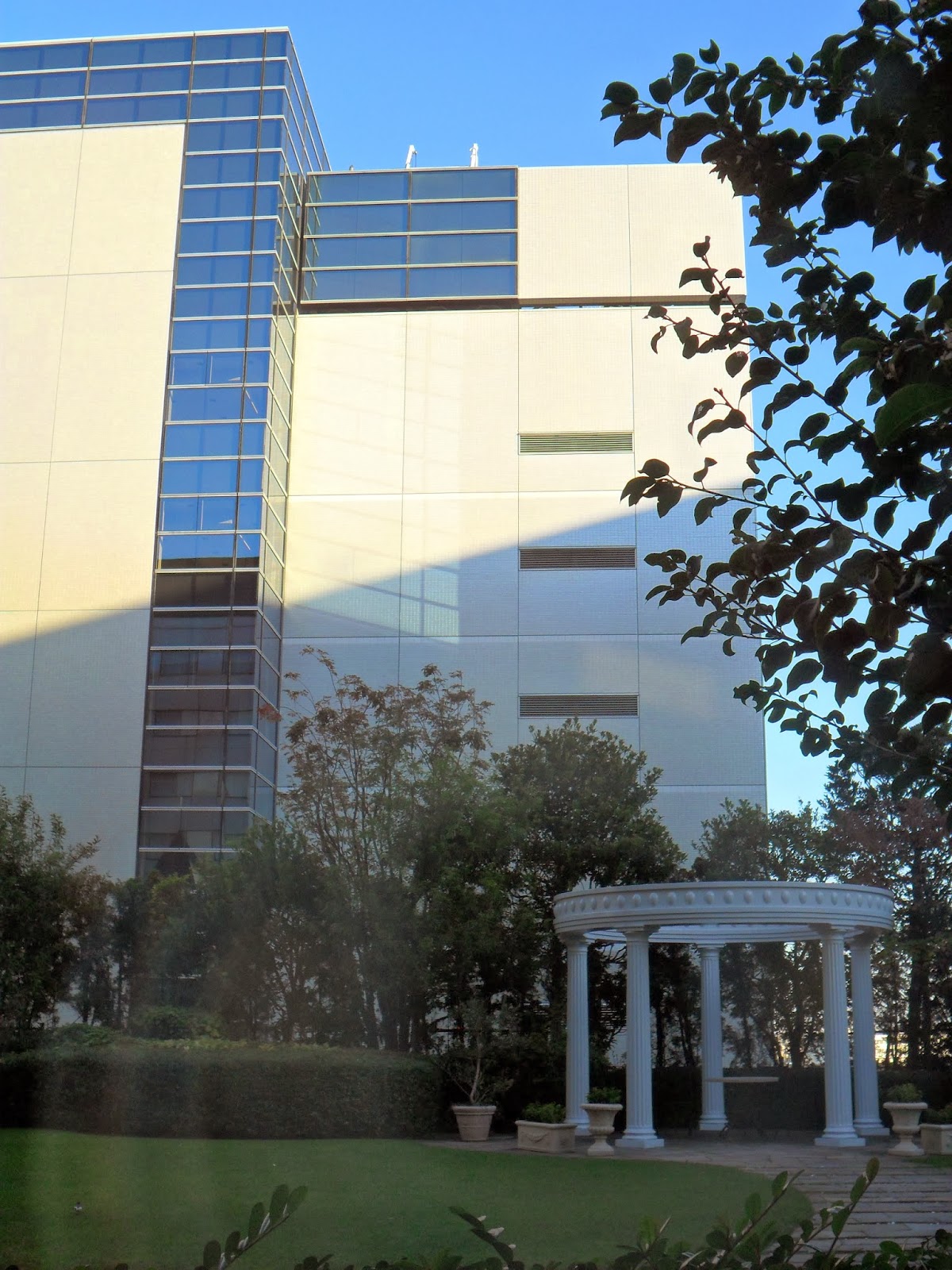
The wedding garden in our hotel
Tuesday was more similar to a conference day: meeting other international participants of to the symposium, waiting for other belgian colleagues, discussing technical details of our collaboration with the NIPR. The latter has highlighted the difference in mentality between europeans and japanese: sometimes asking questions might be frustrating because they say “maybe” or “I don’t know” at the place of a clear “no” and they look more for the problems than for the solutions. Their legendary efficiency actually results in lack of flexibility. Somehow the same as for Germans.

On Wednesday we visited the japanese space agency (JAXA). Wow! I cannot say more, unbelievably exciting! A limited group of us has been allowed to enter the clean lab, where the samples from an asteroid, returned by the Hayabusa spacecraft, are conserved and studied. For that, we were dressed like astronauts, to avoid any contamination. In the evening I’ve skipped the conference banquet because quite tired and because I don’t like much this kind of social events, where one ends talking only with his friends and drinking a lot.

Chapter 3: The symposium.
The official workshop on Polar Research started on Monday but only Thursday and Friday were dedicated to meteorites. There were some good talks, scientifically or practically interesting and outstanding. It was a pity that there was no time for a poster session scheduled, although a number of interesting posters were hanging in the hall. From my side, I’m beginning to know this new community of scientists. Unfortunately, every time I change topic I have to start again to find out who are the big names and who are the crazy guys in the field. This should be the aim of the reception party, but the Japanese are shy when they have to speak english. Therefore, both Thursday and Friday the social events have been a lot of fun for us but not particularly relevant for new scientific collaborations. Anyway, I’ve greatly enjoyed the meeting, the company and the cheerful japanese atmosphere.

Chapter 4: Mission (almost) impossible, back to Belgium.
London Heathrow
If you have read other of my posts recently, you should know that every time I came back to Brussels I have experienced a kind of trauma. This time I had again some troubles with the airline, so I had no time to think to my opposite feelings towards this city. Again Finnair. Although I had a reservation for a JAL flight to Helsinki and then Flybe to Brussels, the threat of a strike has probably frightened enough Finnair for changing my flights. With my great surprise, I’ve realized the day before leaving that I was booked on a Virgin Atlantic flight to London and then British Airways to Brussels. Also at the check-in desk of Virgin the surprise was great: they couldn’t find my ticket until they called Finnair, which should have sent me the new e-ticket reference. No comment! The flight was the longest ever, 12 hrs on a full plane in a tight seat, with partially working entertainment. This is definitively the longest single flight I’ve ever done: 9569 km. I’ve read about a 19 hrs non-stop flight from Brussels to Australia. Well, I could die in a similar situation. The rest of the journey was less close to a nightmare, thanks to a mug of coffee with cinnamon and the shiny shops in Heathrow. Also in Zaventem everything went smooth, except the taxi driver (only French speaking and charged €5 more for the receipt), but that’s Brussels and we have to cope with it.

Anyway, thanks to Finnair I’ve missed two medium size earthquakes in Tokyo area, one on Sunday morning and the last one yesterday evening. As structural geologist, who would like to come back to study fossil earthquakes, what should I say? Perhaps I should really abandon this idea and keep working on meteorites, although I cannot find them as exciting as the shaking of the ground. I wish Japan was closer to Europe. Its culture is so intriguing! For sure I’d like to go back soon.


Tuesday, October 8, 2013

24h in Germany

When people count the possibility of traveling to the rest of Europe among the advantages of living in Brussels, I always say that desiring to escape from this place doesn't make having better feelings towards the city. Anyway, the last week-end I decided to take this opportunity and go to Germany. For tourism? Not exactly. My former organ teacher has given a concert in Ratingen, a town close to Düsseldorf, just 200 km from Brussels. What a nice opportunity for hearing again my teacher and visiting a place where I've never been!

On early Sunday I took a train to Düsseldorf. My first experience with Thalys, the high speed train between France-Belgium-Netherland and Germany. Although I had saved on my smartphone the map of the city, I was too proud to consult it, therefore I got lost from the station to the Altstadt. Oh well, I've seen another side of the city. Then, with the map, I found my way without asking information. Düsseldorf center is not as beautiful as Vienna, but is anyway intriguing, with medieval corners and modern bridges on the Rhine. There are a few old breweries but spanish and italian restaurants are everywhere. Obvious sign of area interested by high rate immigration, as I expected in this dense network of industrial cities (Düsseldorf, Essen, Köln, etc.). Nevertheless, even the area around the central station, where many immigrants live, is clean, newly painted and well maintained, even on Sunday morning. Only a few people were around in the morning, but they waited at the pedestrian traffic light although no cars were arriving. Welcome in Germany!

In the afternoon I took a S-Bahn to Ratingen. What a sweet town! Actually it is a city, but with the atmosphere of a medieval village. The city walls are partly preserved or rebuilt, the center is enclosed by a ring street. The hotel where I stayed was also very cute and... german. I've enjoyed every moment in that town! From the coffee in the "Italienischer Eissalon" to the vegetarischer kebab in a turkish place open till midnight and the delicious breakfast in a bakery with eine Tasse Kaffee as large as that I make at home (I'm not much Italian for that). In this corner also renting or buying a flat is affordable. I wish I can live in a similar place in future. I was afraid of hearing a cryptic dialect, but the local German didn't sound weird to me and I could have a very basic conversation with sellers and normal people. The concert of my former organ teacher was the cherry on the cake! It has been a bit funny, meeting him in front of the church, I guess also for him, but we started immediately talking about music and we were again back in Padova 10 yrs ago.

On Monday morning I took a S-Bahn to Köln. While waiting for the ICE to Brussels, I've walked around. I've been already in Cologne maybe 15 years ago, with my parents. The cathedral is impressive. In a few steps, iper-modern buildings are next to medieval towers or roman roads. That's amazing! The Rhine peacefully continues to record the history of the city. I had the time to do some shopping, finding again the brands I was used to (also in Vienna) but limited by the size of my suitcase. The central station is as large as a gigantic shopping center! Waiting in front of the information screen, I have been asked by 5 people about trains. As usual, it seems I'm an information office in every place I am. In less than 2 hrs I was back to Brussels and the impact was tough, the difference too much obvious. Despite my effort, I'll never get used to live here without complaining for the bad maintenance of the buildings and the pavements. Hopefully I'll find soon another excuse to go to Germany again! I already miss you!

Saturday, September 21, 2013

DRT in Leuven: when the past comes to meet me

The DRT (Deformation mechanisms, Rheology and Tectonics) meeting is a conference organized every second year in a different city in Europe. This has been my first conference ever, when I was at the beginning of my PhD school, in 2005, in Zurich. Then I had to skip the following meeting, in Milan, because of the organ diploma. I went to Liverpool, in 2009. There was one in 2011 in Oviedo, but I was already in the meteorite impact research. After having sent tens of applications for a post-doc in geology and at the end being relocated to Brussels working on a complete different topic, I was sure to have definitively said "farewell" to structural geology and micro structural analysis. I was wrong! The DRT this year is in Leuven, 20 minutes by train: even for fun, I couldn't miss it!

A surprise waited for me. Although I asked a poster presentation, I had a talk. I've presented a side-project I was working on in Vienna, but my speech wasn't good. Amen! I was freezing in that room and I bit distracted by the feeling of being again among structural geologists, some known, some new. Many elders were not there, I don't know if because of contemporaneous fieldwork or teaching. I was the only italian, though my current affiliation is belgian. This was a bit sad. A professor that I met in 2006 remembered that I play organ. Well, this means that I didn't change much in these years, I'm still equally divided between my two great passions: geology and music.

The conference was, anyway, quite interesting. Not only for the state of art in the field, but also for the opportunity of talking of possible collaborations on what I'm working on now. Surprisingly, other geologists are interested in shock metamorphism! The conference has given me also the opportunity to visit Leuven, which was recommended as candidate for moving out of Brussels. The town is really beautiful, with gothic buildings, pedestrians areas, historical squares, and an old catholic university. But I cannot live there: as I was afraid of, the city is sized for students. It would be like living in Oxford. It's not for me, I'm too old for that. Anyway, it was nice to jump back in the past, enjoying travels by train and a conference in a nice, quiet and clean place. Hopefully this was also a glimpse of future.